





















What is project risk?
The PMBOK® 7th edition describes risk as an uncertain event or condition that could positively or negatively affect a project’s schedule, budget, scope, or quality. PMI distinguishes individual risks from overall project risk, which reflects the combined effect of uncertainty on the project as a whole. In PMI's 2025 Project Success Survey, 45% of projects ultimately considered successful had been at risk of failure at some point before completion.
Project risk vs. issue
A project risk is an uncertain event that may affect project objectives, while an issue has already occurred. Risks are assessed by likelihood and impact; issues are managed through ownership and resolution actions. For example, a supplier delay is a risk while the delivery date is uncertain. Once the supplier confirms the delay, it becomes an issue that requires a response.
10 common types of risk in project management
Project risks can affect different areas of a project, including schedules, budgets, resources, technology, and external events. The table below outlines 10 common types and their potential impact.
Risk type | What can happen | Example |
| Schedule risk | Work takes longer than planned | Testing starts late because development misses its deadline |
| Cost risk | Spending exceeds the approved budget | Material prices increase |
| Scope risk | Requirements change or expand | Stakeholder adds new features |
| Resource risk | Required people or skills are unavailable | Limited access to specialized technology |
| Technical risk | Technology fails to perform as expected | Integration fails during testing |
| Operational risk | Internal processes disrupt delivery | Approval workflow slows procurement |
| Stakeholder risk | Decisions or expectations affect progress | Sponsor delays approval |
| Vendor risk | External provider misses commitments | Supplier misses delivery |
| Compliance risk | Legal or regulatory requirements affect work | New privacy requirement changes implementation |
| External risk | Outside events disrupt the project | Severe weather delays site work |
1. Schedule risk
Schedule risk is the possibility that work will take longer than planned. Causes can include delayed approvals, technical problems, or dependencies. PMI notes that schedule delays can increase costs and postpone expected benefits.
Project managers should focus on the risk driver, not only the deadline. If testing depends on a vendor completing an integration first, the vendor dependency is the source and the testing delay is the impact.
2. Cost risk
Cost risk is the possibility that project expenses will exceed the approved budget. Common sources include inaccurate estimates, expiring vendor quotes, price increases, scope changes, or inflation that was not accounted for in long-term planning.
For example, if a supplier bid expires before approval, the project may have to purchase the same materials at a higher price. Tracing the added cost back to its source helps teams choose the right response.
3. Scope risk
Scope risk occurs when uncertainty about requirements or deliverables changes the work needed to complete the project. It can result from uncontrolled changes, late requirements, or defects that require rework.
Note that not every scope change is scope creep. A requirement found during testing may be necessary, but the team still needs to assess its effect on time and cost.
4. Resource risk
Resource risk occurs when a project may not have the people, skills, equipment, or capacity needed to complete planned work. This can include limited access to specialized technology or hardware, especially when procurement lead times are long.
For example, if a project requires equipment in short supply and the team does not allow enough lead time, the resource risk can become an issue once the equipment is unavailable when needed. The same principle applies to people: when several activities depend on one specialist, a single absence can affect multiple parts of the schedule.
5. Technical risk
Technical risk concerns whether the technology, design, or solution can meet project requirements. Causes include incomplete designs, untested technology, integration problems, or unsupported assumptions.
One warning sign is relying on a technical assumption that has not been tested. Early prototypes or integration tests can confirm whether that assumption is valid before later tasks depend on it.
6. Operational risk
Operational risk comes from the processes used to deliver the project. Procurement delays, poor handoffs, unclear responsibilities, or unavailable equipment can slow execution. A technically sound project can still fall behind if approvals or internal processes slow the work.
7. Stakeholder risk
Stakeholder risk occurs when decisions, expectations, or involvement disrupt project progress. Conflicting priorities or delayed approvals can lead to rework and schedule delays. Even limited involvement can create risk when a stakeholder controls a key approval, because one delayed decision may hold up dependent work.
8. Vendor risk
Vendor risk arises when an external provider may fail to meet a delivery, service, or contractual commitment the project relies on. Common sources include late delivery, service failures, or limited capacity. The impact depends on how much downstream work relies on the vendor, so even a short delay can stop dependent tasks or push later milestones.
9. Compliance risk
Compliance risk occurs when legal, regulatory, contractual, or industry requirements change how the project must be delivered. A new privacy requirement, for example, may force changes to system design or data handling.
The timing of a new requirement increases its impact: A requirement identified early can be included in the project plan, while one discovered later may require redesign or procurement changes.
10. External risk
External risk comes from events or dependencies outside the project team’s control, such as severe weather, market changes, supply disruptions, or delays in other projects your work depends on. These risks can affect delivery even when the team meets its commitments.
For example, a project may depend on another team completing a system upgrade before integration can begin. Since the project manager cannot directly control that work, the response should focus on monitoring the dependency, confirming contingency options, and adjusting sequencing if the upstream project is delayed.
How project risks can trigger other risks
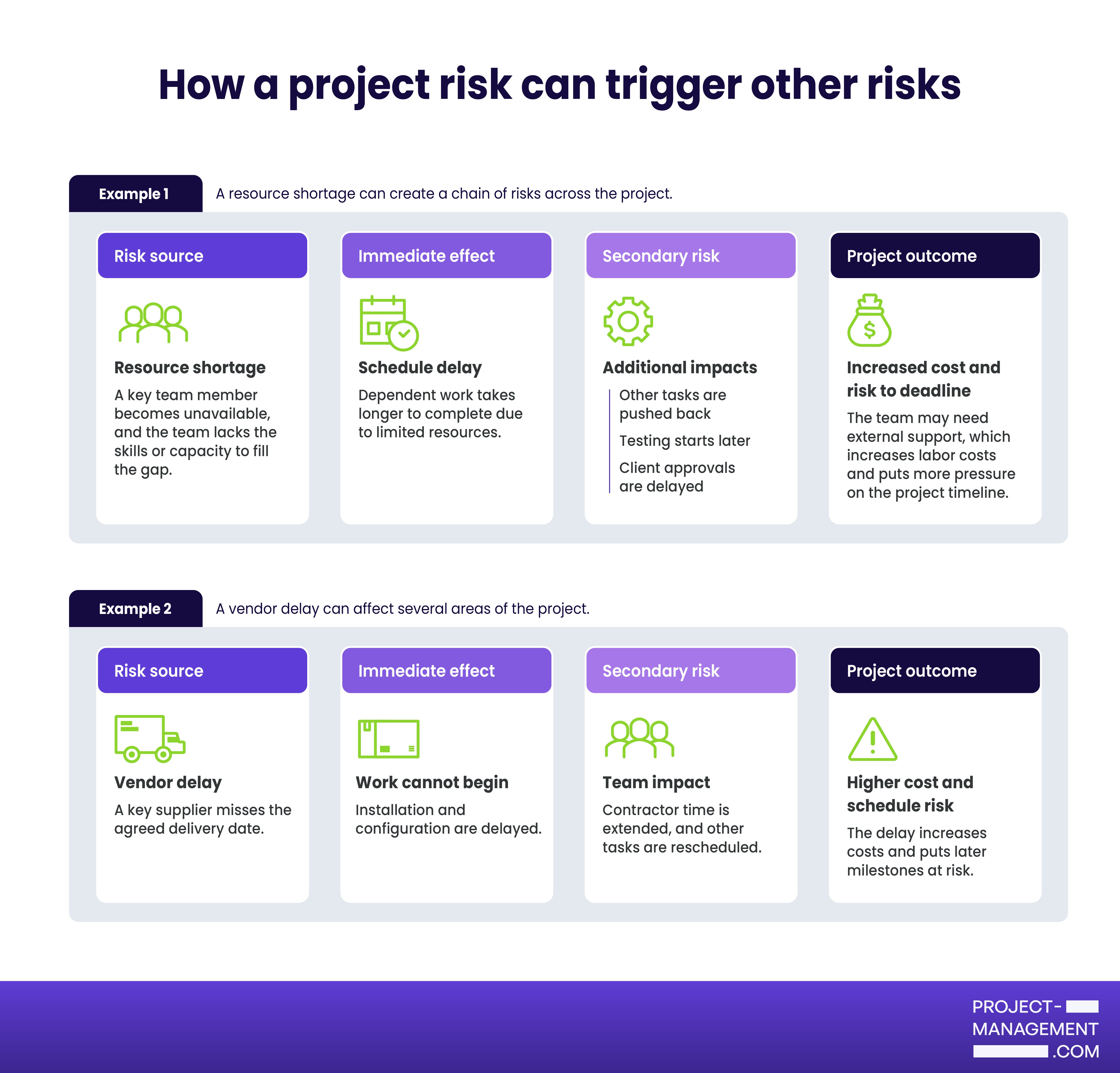
A project risk may start in one category but affect several parts of the project. A resource shortage, for example, can delay dependent work and increase labor costs if the team needs external support. Looking only at the final effect can hide the original source of the problem.
Risk source vs. risk impact
The risk source is where the uncertainty begins, while the risk impact is the effect on the project if the event occurs. Separating the two helps project managers avoid treating consequences such as delays or cost overruns as the risk itself.
Risk event | Primary source | Immediate impact | Secondary impact |
| Key developer leaves | Resource | Development slows | Schedule delay and contractor costs |
| Supplier misses delivery | Vendor | Installation cannot begin | Schedule and cost impacts |
| Stakeholder adds requirements | Scope | Additional work | Higher cost and later completion |
| Integration fails | Technical | Rework required | Schedule and budget pressure |
| Approval takes too long | Stakeholder | Dependent work cannot begin | Schedule delay |
How to identify project risks
Project risk identification should examine the assumptions and dependencies, while also considering risks that may be less obvious. A risk review should test what the plan assumes will remain true and what happens if those conditions change.
- Review assumptions. Check estimates, resource availability, timing, and external conditions the plan depends on. If an assumption has little evidence or no contingency, validate it before treating it as reliable.
- Examine dependencies. Look for tasks, approvals, vendors, or systems that control when other work can begin. A single dependency warrants more attention when several activities rely on it.
- Use lessons from previous projects. Review earlier delays, change requests, rework, and vendor issues. When the same problem appears across projects, treat it as a recurring risk rather than an isolated event.
- Ask stakeholders and project teams. Not every risk is obvious from the project plan, and team members may notice unusual scenarios that others have overlooked. A sponsor can flag approval risks, while a technical lead may identify integration or capacity concerns. Even an unlikely suggestion can reveal a real dependency or failure point worth assessing.
- Trace each risk to its source. When a risk is identified, separate its source from the event and potential impact. For example, “testing may be delayed” describes an impact, while late vendor delivery or limited developer availability may be the source. This helps the team address the cause before it affects the schedule or budget.
How to document risks in a risk register
A risk register should record the information needed to assess the risk and assign ownership. At minimum, include the risk statement, category, likelihood, impact, owner, and response plan. A risk entry separates the source, event, and impact rather than using a general label such as “schedule risk.”
Risk statement | Category | Likelihood | Impact | Owner | Response |
| Hardware delivery depends on one supplier, so shipment may arrive after the installation date and delay testing | Vendor | Medium | High | Procurement lead | Confirm backup supplier and review delivery status weekly |
The register should also define the trigger for action. For example, “supplier misses the first shipment milestone” gives the owner an escalation point and allows action before the risk affects the schedule.
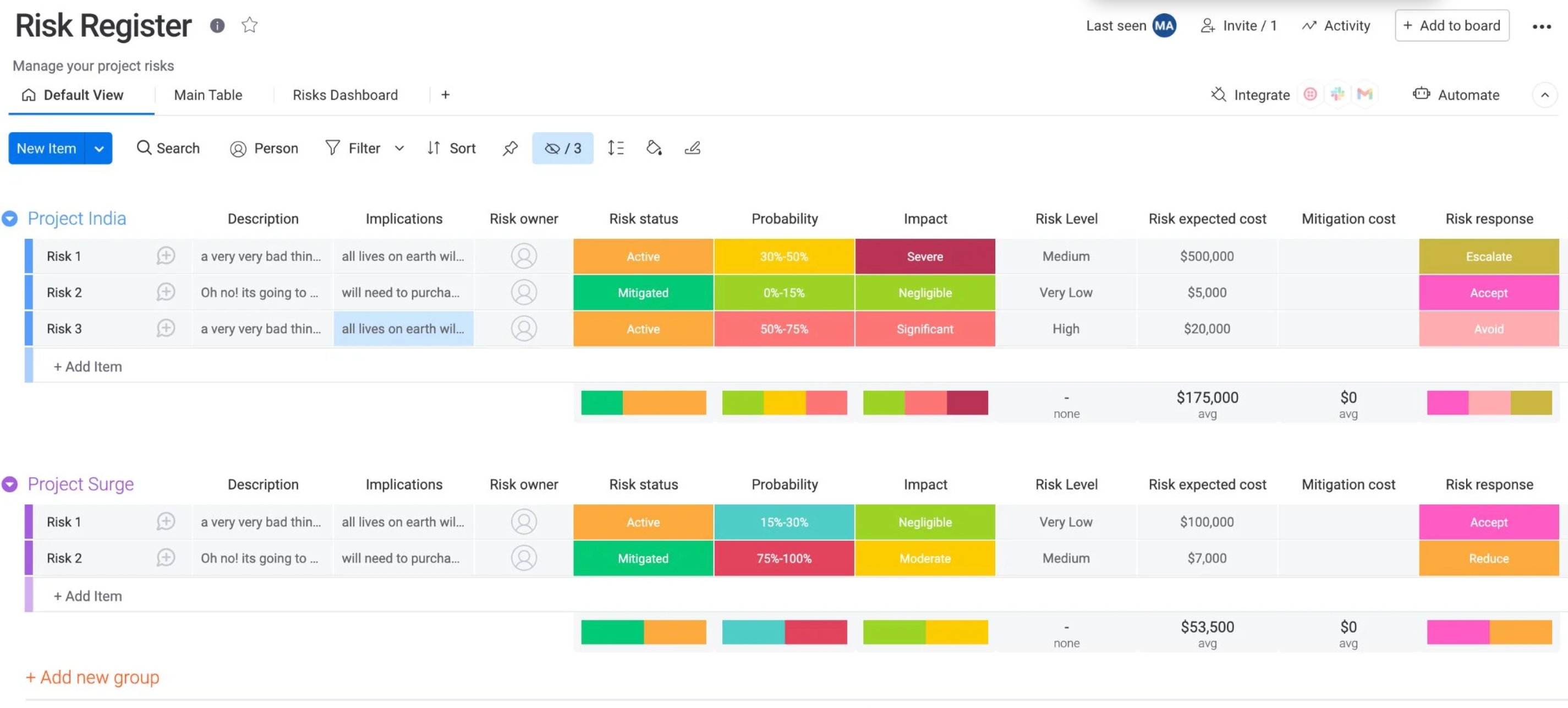
Project management platforms make risk tracking easier by keeping risk owners, due dates, and response actions in the same workspace as project tasks. monday.com uses custom fields and automations to flag high-priority risks and remind owners when follow-up is due.
| Risk matrix vs. risk register: A risk matrix helps teams prioritize risks by comparing likelihood and impact, while a risk register records each risk, its owner, response, and status. Use the matrix to determine priority, then track the risk in the register. |
How to respond to project risks
Project teams respond to threats by avoiding, mitigating, transferring, or accepting them. The response should address the risk source and reduce either its likelihood or effect. A single risk may also require several responses, such as transferring contractual exposure while mitigating operational impact.
- Avoid the risk: Change the planned approach to remove the source of the threat. For example, a team may replace untested technology if the exposure exceeds the project’s risk tolerance.
- Mitigate the risk: Take specific actions to make the risk less likely or reduce its effect on the project. An early integration test, for example, can expose technical problems before they affect later work.
- Transfer the risk: Shift specific financial or contractual responsibility to a third party through insurance or a contract. The team should still document which responsibilities remain with the project.
- Accept the risk: Accept the exposure when its expected impact falls within agreed risk tolerance. Active acceptance may still include contingency funds or a contingency plan.
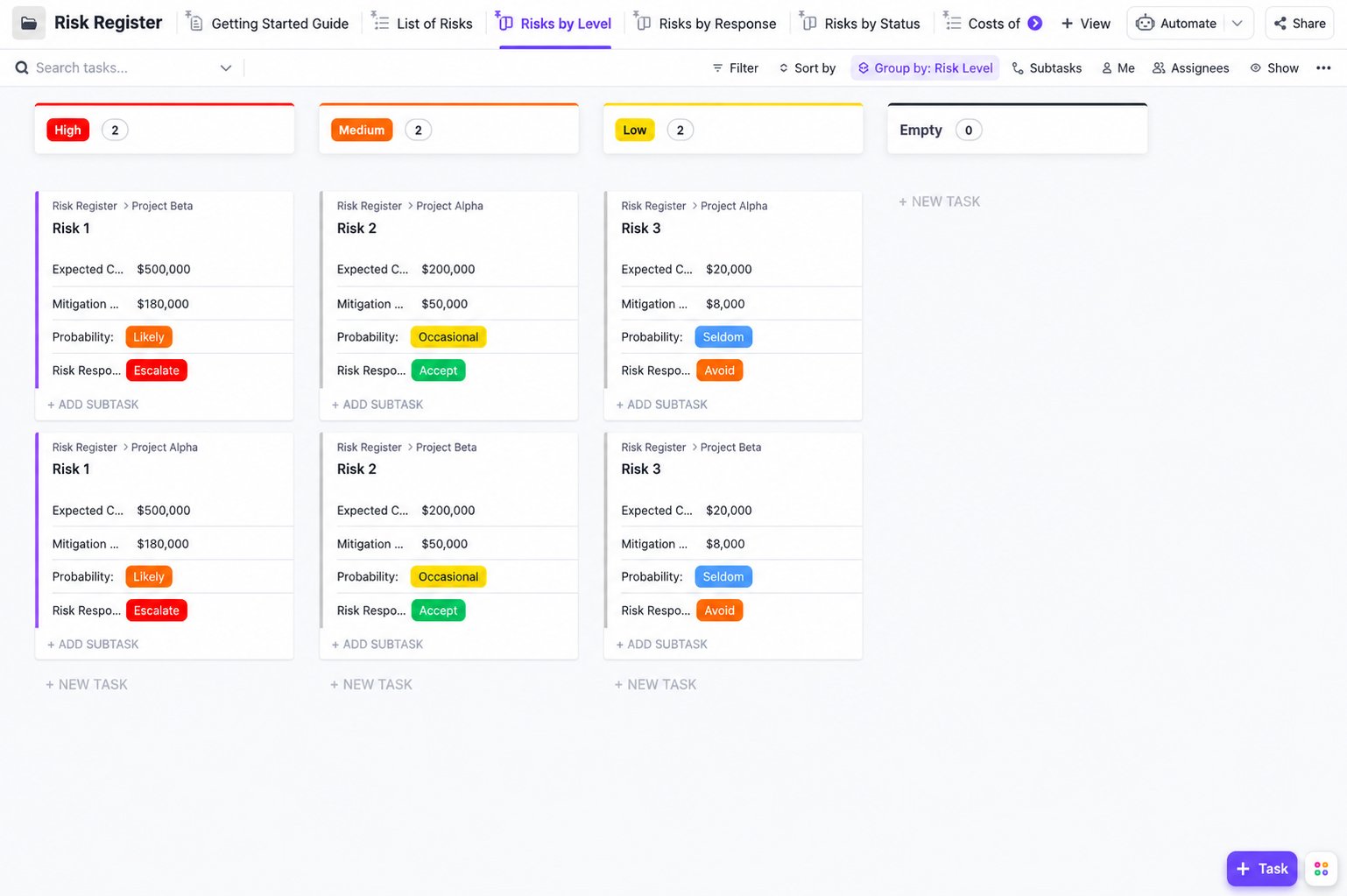
Project management platforms such as ClickUp can help teams carry out risk responses by assigning tasks, owners, due dates, and status updates in one workspace. Automations can also notify owners when a risk reaches a defined trigger or needs escalation.
Common mistakes when managing project risks
Risk management often breaks down when risks are recorded poorly or reviewed too infrequently. These mistakes can hide unresolved risks even when the register appears up to date.
- Recording impacts instead of risks. Entries such as “schedule delay” or “budget overrun” describe outcomes. A clear entry identifies the uncertain event that could cause the outcome.
- Treating all risks as independent. One risk can affect several project areas. A resource shortage, for example, may delay work and increase labor costs.
- Using vague risk statements. Terms such as “vendor problems” or “technical issues” make it harder for owners to decide what action to take. Risk statements should identify the source, event, and expected impact.
- Reviewing risks only at scheduled checkpoints. Risk likelihood or impact can change between reviews. Reassess priority risks when assumptions, dependencies, supplier status, or staffing changes.
- Assigning an owner without defining an action trigger. Ownership alone does not tell someone when to act. A trigger such as a missed supplier milestone gives the owner a specific escalation point.
- Keeping closed risks in the register too long. Risks that remain open for long periods should be reviewed and updated, not left unchanged. Reassess their likelihood, impact, owner, and response; if a risk no longer requires monitoring or action, close it.
FAQs
What are the most common risks in project management?
Common risks in project management include schedule delays, cost overruns, scope changes, resource shortages, technical problems, vendor failures, and stakeholder issues. Projects may also face compliance or external risks, depending on the industry and operating environment.
How do you prioritize project risks?
Project risks are commonly prioritized by assessing their likelihood and potential impact. Higher-priority risks usually require closer monitoring or a planned response. Teams can use a risk matrix to compare exposure consistently and decide where to direct attention first.
What should a project risk register include?
A risk register should identify the risk, its likelihood and impact, the owner, and the planned response. A clear risk statement should also distinguish the cause, uncertain event, and potential consequence so the team can respond to the source rather than only the outcome.